- Silica Free News
- Posts
- Caesarstone ICON vs IceStone vs Soapstone
Caesarstone ICON vs IceStone vs Soapstone
Which Silica-Free Countertop is the Best?

Three materials. Three fundamentally different technologies. All silica-free — but for entirely different reasons.
Caesarstone ICON is an engineered surface that eliminates crystalline silica through advanced mineral fusion. IceStone is a handcrafted composite of 100% recycled glass set in Portland cement. Architectural Soapstone is a natural metamorphic rock whose talc-rich geology makes it inherently free of crystalline quartz.
These materials share a meaningful baseline for fabricators, distributors, and specifying professionals: none of them carry the crystalline silica content associated with conventional engineered quartz. But beyond that common ground, they diverge in almost every other dimension — composition, performance, maintenance, aesthetics, and cost.
This comparison is not here to pick a winner. It is here to give architects, designers, and distributors the technical grounding to match each material to the right project. The differences between these three surfaces are real, significant, and matter for specification decisions.
Quick Verdict
Choose Caesarstone ICON if the project needs consistent, repeatable engineered aesthetics, zero ongoing maintenance, and a certified crystalline silica-free specification for fabricator safety compliance.
Choose IceStone if recycled content certifications are a primary specification driver, the design can work with terrazzo-style slab variation, and the project may include outdoor or high-UV applications.
Choose Architectural Soapstone if thermal performance is critical, the design language calls for natural patina and material authenticity, or the fabricator needs on-site workability for custom integrated details.
At a Glance: Specifications Table
Characteristic | Caesarstone ICON | IceStone | Architectural Soapstone |
|---|---|---|---|
Material Category | Advanced Fusion (Engineered) | Cementitious Composite | Natural Metamorphic Rock |
Crystalline Silica | <1% (certified) | None (glass/cement) | None (talc-based) |
Recycled Content | ~80% | 75% | 0% (quarried natural) |
Primary Binder | Proprietary fusion resin | Portland cement | Natural metamorphism |
Specific Gravity | Standard engineered | 2.31 g/cm³ | 2.956 g/cm³ |
Porosity | Non-porous | 0.18% unsealed | ~0.1% natural |
Mohs Hardness | High resistance | Glass aggregate ~6.0 | 2.5–3.5 |
UV Stability | Interior only | High (exterior capable) | High (natural) |
Maintenance | None required | Annual seal + wax | Periodic mineral oil |
NSF 51 (Food Zone) | Certified | Certified | Naturally food safe |
LEED Contribution | Yes | Yes | Yes |
B Corp / Cradle to Cradle | N/A | B Corp + C2C Silver | N/A |
Declare Label | Third-party verified | N/A | N/A |
Warranty | Limited lifetime | 10-year (certified fab) | Varies by fabricator |
What Each Material Actually Is
Understanding what you are specifying starts with the material science.
Caesarstone ICON: Advanced Fusion Engineered Stone

ICON is classified by Caesarstone as an "advanced fusion surface." This refers to a proprietary manufacturing process that replaces quartz crystals with a blend of amorphous silica, recycled glass, and high-performance natural minerals, bound together with a proprietary fusion resin. The process also incorporates titanium dioxide at concentrations of 0–4% to optimize color and opacity.
The result is an engineered surface that contains less than 1% crystalline silica — the threshold used across the industry to define "silica-free" in the context of fabrication safety regulations. Recycled content sits at approximately 80%, predominantly post-industrial glass.
One distinct technical achievement of the ICON line is translucency management. By selecting minerals with varying refractive indices, Caesarstone has engineered a surface where light penetrates the upper layers and reflects off internal mineral structures, producing visual depth that references the complexity of semi-precious stone. This is not a surface finish effect — it is a compositional property.
IceStone: Cementitious Recycled Glass Composite

IceStone belongs to a different category entirely: cementitious composites with recycled glass aggregate. The material has three ingredients — 100% recycled glass, Portland cement, and non-toxic pigments. No petrochemical resins. No plastic binders. This composition renders IceStone approximately 99.5% inorganic.
The glass aggregates are sourced from post-industrial and post-consumer streams: beer bottles, soda bottles, windshields, stained glass. Portland cement acts as the structural binder, creating a material that behaves mechanically like high-strength concrete but with the polished appearance of stone. Because the cement binder is UV-stable, IceStone performs in outdoor applications where resin-based surfaces degrade.
IceStone is also a handcrafted product. Each slab is individually produced, meaning visible variation between slabs is inherent and expected — closer to artisan terrazzo than to the slab-to-slab consistency of engineered stone.
Architectural Soapstone: Natural Metamorphic Benchmark
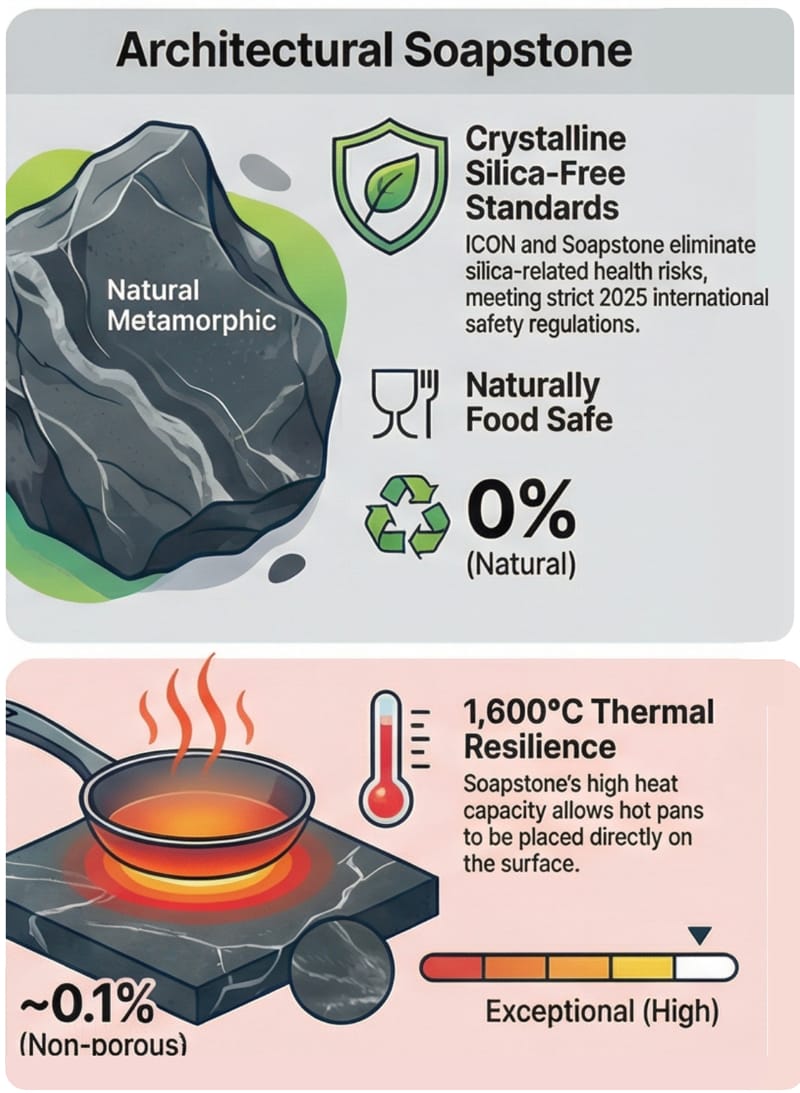
Soapstone — formally known as steatite — is a natural metamorphic rock formed under extreme geological pressure from ultramafic rock. The process rearranges minerals into a dense, interwoven structure without melting, producing a material with a characteristic smooth texture and a set of physical properties that have made it a preferred surface for centuries.
Architectural-grade soapstone (as distinct from the softer artistic grade) contains approximately 30–50% talc, with the remainder comprising magnesite, chlorite, dolomite, and trace minerals. Its silica-free status is geological: the dominant mineral is talc — a magnesium silicate — not quartz. This is why soapstone has served as the standard material for laboratory countertops and medical sinks in environments where surface safety is non-negotiable.
The short version: ICON is engineered stone redesigned for a post-silica era. IceStone is recycled glass set in concrete. Soapstone is a geological formation that happens to have the right mineral makeup for surfaces.

The Low Silica / No Silica Cheat Sheet
The 2026 Countertop Silica Classification Guide breaks down what each classification actually means, where the Q-rating system applies, and which brands fall where — so you can specify or stock with confidence.
Crystalline Silica: Where Each Material Stands
All three qualify as silica-free for practical specification purposes, but the mechanism differs — and that distinction matters for compliance documentation.
Caesarstone ICON carries an explicit certification: less than 1% crystalline silica. This aligns directly with the regulatory language used by OSHA and international equivalents when defining silica-free fabrication environments. For distributors or fabricators who need to demonstrate compliance, ICON provides a documented specification.
IceStone does not carry a specific crystalline silica percentage certification, but its composition makes the designation inherent. Glass is amorphous silica by definition — its molecular structure is non-crystalline. Portland cement does not introduce crystalline silica. The material is silica-free based on what it is made of, not a certified threshold.
Soapstone contains approximately 63% silica by mass, measured as natural mineral silica within talc and associated minerals — not as crystalline quartz. The distinction matters: crystalline silica (free quartz) is the form associated with silicosis risk during fabrication. Soapstone's silica is bound within its metamorphic mineral structure and does not present the same exposure hazard. Its long-standing use in laboratory environments is evidence of this safety record.
What this means for fabricators: All three materials reduce crystalline silica exposure risk relative to conventional engineered quartz. ICON provides the clearest certification path for regulatory documentation. IceStone and soapstone are safe by composition. Fabricators handling any of these three materials should still use standard dust control practices, but the primary silica-related compliance concern associated with quartz fabrication does not apply.
Performance Head-to-Head
Thermal Resilience
Soapstone holds a significant advantage here. Its physical properties give it a "heat sink" quality — it absorbs heat, retains it, and releases it slowly. The stone withstands temperatures up to 1,600°C (2,912°F). In practical terms: hot pans can be placed directly from a range onto soapstone without risk of thermal shock, surface damage, or discoloration. This has made it the standard in professional culinary environments and serious cooking kitchens for generations.
IceStone performs well thermally. It carries a Class 1(A) fire rating under ASTM E-84 with zero flame spread and zero smoke density. The caveat: IceStone contains large glass aggregates within a cement matrix, and localized sustained heat can cause differential thermal expansion at that interface. The recommendation from IceStone is to use trivets for prolonged direct heat contact.
Caesarstone ICON handles the thermal demands of standard residential and commercial kitchen use — steam, incidental warm contact, ambient temperature variation — but it is engineered for interior thermal stability, not extreme heat. Like all resin-bound surfaces, direct sustained high-heat exposure is not its strength.
In practice: For professional culinary installations or clients who move pots directly from range to counter, soapstone provides a heat tolerance margin the others do not. For standard kitchen applications, all three perform adequately.
Mechanical Strength and Density
IceStone is structurally robust. Compressive strength ranges from 13,000 to 16,000 psi — comparable to high-grade granite — and flexural strength reaches 890 psi. These figures support large-span installations and island applications without requiring extraordinary substrate reinforcement.
Soapstone is exceptionally dense — specific gravity of approximately 2.956 g/cm³, denser than most granites and marbles. That density is what makes it naturally non-porous. Its Mohs hardness, however, sits between 2.5 and 3.5, making it the softest of the three. It will scratch. The distinction worth communicating to clients: soapstone does not chip or shatter under impact the way harder, more brittle materials do. It dents and scratches — and those scratches can be sanded out entirely on-site.
Caesarstone ICON is engineered for impact resistance and fabrication workability. Its mineral blend is optimized to reduce chipping risk during cutting and transport, and the material supports complex fabrication profiles — waterfall edges, integrated features, intricate curves — with consistent results.
Surface Porosity and Hygiene
Soapstone and ICON are both non-porous without any treatment or sealing.
Soapstone's near-zero water absorption (~0.1%) means it does not harbor bacteria, allow liquid penetration, or react with acids, alkalis, or solvents. Wine, vinegar, citrus, cleaning chemicals — none of them etch or stain soapstone. This intrinsic property is why it has served laboratory and medical environments for generations. No topical sealers are required, now or ever.
Caesarstone ICON is non-porous through its fusion manufacturing process, which creates a sealed surface without topical treatment. It holds NSF 51 certification for food zone use, permitting specification in commercial food preparation environments.
IceStone is semi-porous in its natural state, due to the cementitious binder. Unsealed porosity sits at 0.18%. When properly treated with penetrating sealers, it becomes highly stain-resistant and performs well in active kitchen environments. The maintenance requirement — penetrating sealer plus carnauba wax topcoat, recommended annually — is manageable but real.
What this means for distributors: IceStone has an ongoing maintenance conversation built into its sales cycle. The sealing protocol needs to be clearly communicated before purchase and followed through after installation. ICON and soapstone do not carry this requirement.
Fabrication and Installation
Working with Caesarstone ICON
ICON fabricates using the same CNC equipment and wet diamond tooling standard for conventional quartz. Fabricators trained on quartz will find the workflow familiar. The material's resilience during fabrication reduces chipping risk. Seam quality and edge profile consistency are in line with standard engineered stone outcomes. Caesarstone's "Master of Stone" program provides fabrication training and professional standards documentation.
Working with IceStone
IceStone requires wet diamond tools or water jets — dry cutting is not suitable for the glass-cement matrix. Finishing follows a specific polishing sequence, from 100 to 3,000 grit, to achieve a high-gloss surface. Honed and sandblasted finishes are also available for a more tactile result.
IceStone slabs are large — approximately 52.5" × 96" — and heavy at approximately 570 lbs per slab. Forklift unloading and pipe rack or A-frame storage at a 20-degree angle are required. IceStone mandates installation by certified fabricators for the 10-year limited warranty to apply.
Working with Architectural Soapstone
Soapstone is arguably the most workable of the three for custom on-site fabrication. Its talc content makes it significantly less brittle than granite, quartzite, or most engineered surfaces. Fabricators can execute custom drainboards, hand-carved radius corners, and integrated sinks on-site with lower risk than harder materials would allow. Minor surface imperfections can be sanded and refinished in place.
Worth noting: soapstone's density means weight is a real consideration. At 1.25" thickness, the material weighs approximately 15 lbs per square foot. Cabinetry must be verified as level and reinforced — particularly for larger slabs or integrated sink cutouts.
Aesthetics and Design Applications
The three materials address different design languages. Direct aesthetic comparison misses the point — they are suited to different project types.
Caesarstone ICON
ICON is built around engineered translucency and visual depth. Its fusion technology allows light to penetrate the upper surface layers and reflect off internal mineral structures, producing a complexity that references semi-precious stone. Current colorways include:
8101 Clearlight — Bone-white with dissolving grey veins; a quiet, misty presence suited to contemporary and transitional interiors
8100 Calacatta Lacebound — Ivory with taupe and grey veins; warm luminosity in traditional and modern applications
8477 Ocean Sage — Sage green with matcha-toned veining referencing seaweed and ocean foam; suited to biophilic and nature-referencing design directions
8521 Wild Taj — Beige with golden-orange oxidized mineral patterns; references natural clay and stone formation
Color is consistent and repeatable across slabs. This is a meaningful practical advantage for multi-slab projects, large islands, or commercial applications where slab matching matters.
IceStone
IceStone's character comes from its glass aggregates. The surface is terrazzo-like, vibrant, and inherently variable — every slab is slightly different. Colorways range from bold statement choices (Cobalt Ice, Amber Pearl) to quieter neutral reads (Alpine White, Fogbound). The material is used as countertops, wall cladding, flooring, and backsplash material, providing visual continuity across a space.
IceStone's aesthetic is most at home in projects with a sustainability narrative, in boutique hospitality, or in bespoke residential projects where material originality matters as much as the design itself. Clients who appreciate craft and uniqueness in their surfaces are the right audience for this material.
Architectural Soapstone
Soapstone's aesthetic is the most restrained of the three — and intentionally so. Black soapstone develops a deep, dramatic tone that creates a formal contrast with light cabinetry. Green varieties maintain lighter sage-to-olive tones even with regular oiling, lending themselves to farmhouse, rustic, and earthy design directions. The stone's veining is soft and organic, never distracting.
Soapstone appeals to projects that prioritize material authenticity — farmhouse kitchens, arts-and-crafts renovations, professional culinary studios, historic restorations. Its "living finish" — the fact that it evolves as the kitchen ages — is the selling point for the right client.
Worth noting: That patina development must be clearly communicated during the specification process. Clients who expect a surface to look the same in ten years as it does at installation are not the right match for soapstone. The ones who find that quality appealing will become loyal advocates for the material.
Sustainability and Certifications
All three materials contribute to LEED projects, though the pathways differ.
Certification | Caesarstone ICON | IceStone | Soapstone |
|---|---|---|---|
LEED Compliance | Contributing | Contributing | Contributing |
Greenguard Gold | Certified | Zero VOC emissions | Zero VOC emissions |
NSF/ANSI 51 | Food zone certified | Food zone certified | Naturally food safe |
B Corp | N/A | Certified | N/A |
Cradle to Cradle | N/A | Silver | N/A |
Declare Label | Third-party verified | N/A | N/A |
IceStone holds the strongest environmental certification stack. B Corp and Cradle to Cradle Silver status are supported by documented manufacturing practices: 98% water recycling and more than 13 million pounds of glass diverted from landfills to date. For projects where sustainability credentials are a specification requirement — LEED, WELL, Living Building Challenge — IceStone is the strongest specification among these three.
Caesarstone ICON's environmental case rests on its ~80% recycled content, its crystalline silica-free manufacturing, and a Declare Label that provides third-party materials transparency verification. It holds Greenguard Gold and NSF 51. It is part of Caesarstone's stated corporate commitment to transitioning its full product portfolio to crystalline silica-free surfaces by end of 2026.
Soapstone's environmental profile operates differently: minimal processing, no toxic chemicals used in quarrying, a service lifespan exceeding 100 years, and 100% recyclability at end of life (crushable for roadbed or repurposing in other architectural applications). Its embodied energy is low and amortized over a multi-generational useful life. Soapstone does not hold the same third-party certifications as the engineered options, but its baseline environmental footprint is fundamentally low.
Decision Framework: Matching Material to Project
Choose Caesarstone ICON if:
Consistent, repeatable color across multiple slabs is required
The client expects zero ongoing maintenance
The design calls for engineered translucency and visual depth
A certified crystalline silica-free specification is required for fabricator safety compliance
The application is interior residential or commercial
Choose IceStone if:
Recycled content certifications are a primary specification requirement
The design accommodates and celebrates natural slab variation and terrazzo aesthetics
The project includes outdoor or high-UV applications
The client understands and accepts the annual sealing maintenance commitment
B Corp or Cradle to Cradle specification is required for sustainability documentation
Choose Architectural Soapstone if:
Exceptional thermal performance is critical — direct heat contact or professional culinary use
Natural patina development and material evolution are desirable or specifically requested
The design language is farmhouse, rustic, historic, or "living"
Custom on-site fabrication is needed — drainboards, integrated sinks, carved details
A naturally non-porous surface with zero topical treatment is required
Disclaimer: Silica Free News is an independent publication covering silica-free and low-silica surface materials for distributors, architects, interior designers, and other industry professionals in the United States and Canada. Our content is provided for general informational purposes only and does not constitute legal, regulatory, technical, engineering, health and safety, or professional specification advice.
Although we make reasonable efforts to provide accurate and current information, product specifications, compositions, certifications, availability, and regulatory requirements may change. Readers should verify all material information directly with the manufacturer and consult the applicable legal, regulatory, or governmental authority before specifying, purchasing, fabricating, or installing any product.